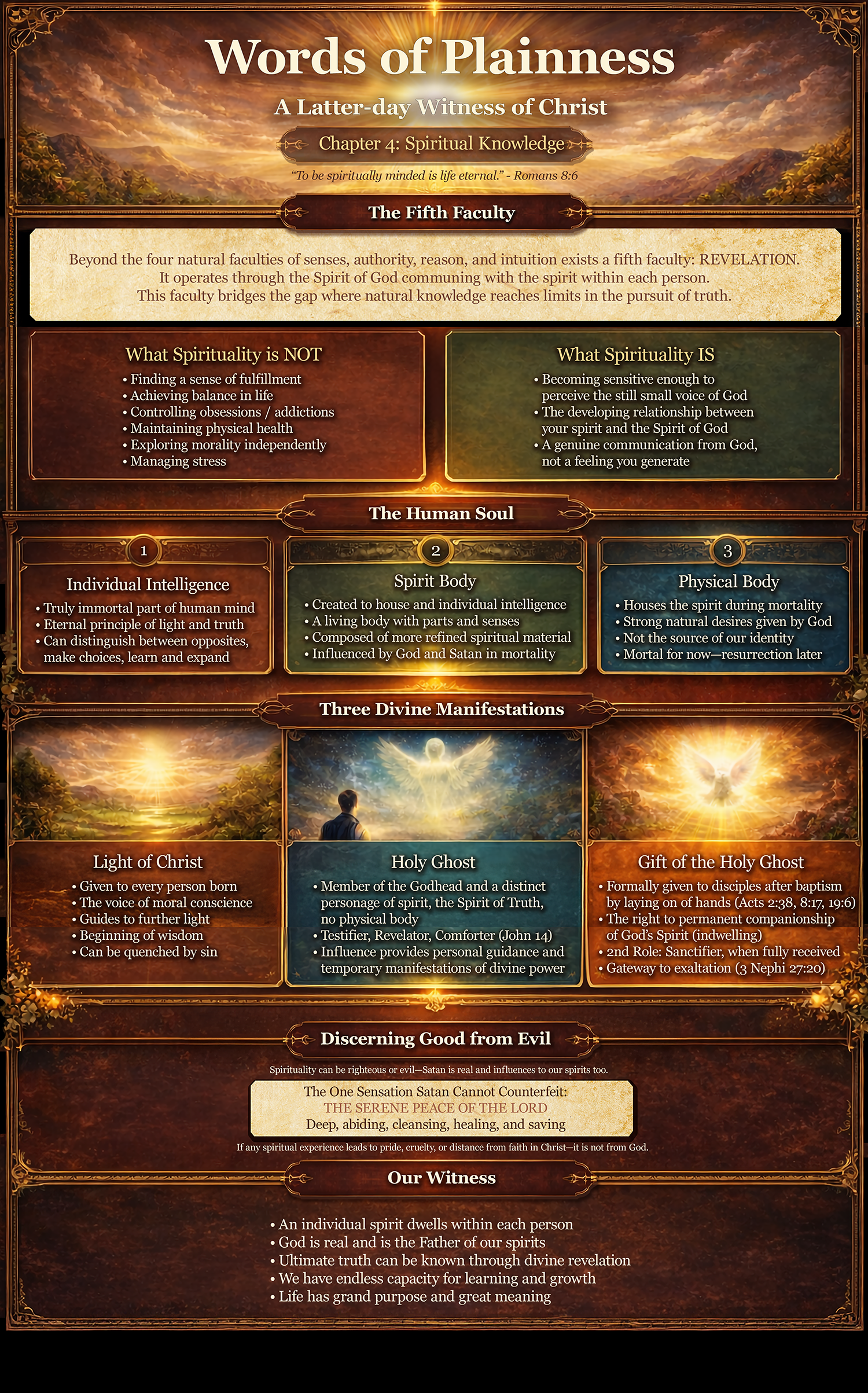
The Fifth Faculty
There are many pursuits that ennoble and enrich human life: great and moving works of literature, valuable accomplishments in the arts that please the senses and evoke strong emotions, tremendous progress in scientific learning and valuable resultant technologies, noble achievements in mathematics, studies of history and geography that fill us with a sense of our place in the world, awesome feats of engineering, and welcome advances in medicine. However valuable these may be, none of them can give us knowledge of ultimate truth or save us from our mortal condition.
The previous chapter explored the four natural faculties by which all human beings acquire knowledge: senses, authority, reason, and intuition. These faculties are gifts from God, and through them we have built civilizations, cured diseases, and explored the cosmos. Yet we also discovered their ceiling—there are questions that exceed their reach.
As Latter-day Saints, we affirm that a fifth faculty exists, one that completes the other four. This faculty does not contradict natural knowledge; it bridges the gap where senses, authority, reason, and academic intuition reach their limit. We call this faculty revelation, and it operates through the Spirit of God communing with the spirit within each person.
Across centuries and cultures, people of faith have affirmed that our mortal lives are not the sum total of our existence. Latter-day Saints stand with them in this conviction—and add our own witness. There is more. We are witnesses of the existence of a power that can allow us to rise above our current existence into something more pure, more perfect, and more whole—not only in this life, but after. Spirituality is required if you wish to experience this for yourself.
What Spirituality Is Not
Many today define spirituality as merely finding a sense of fulfillment, achieving balance in the various aspects of life, controlling obsessions, maintaining physical health, exploring morality, embracing responsibilities, and managing stress. These things are right and good. They are part of life, but these are not spirituality.
Our physical bodies have an undeniably strong nature. It is so easy and pleasing to follow the many cravings of the flesh. It is not wrong that these desires exist. We believe they were given to us by God. A prophet of God once said, "Men are that they might have joy" (2 Nephi 2:25). But this does not mean that God intended for us to completely submit to our physical natures, making choices out of base instinct alone. Our physical bodies are only one aspect of our complex existence. Self-control is only a beginning to spirituality.
The Human Spirit Within
True spirituality has to do with far more vital and vibrant aspects of our existence than the flesh. Those who are acquainted with spirituality often speak of the human mind and heart. The scriptures only briefly explain the concepts of the human mind and heart, but it is clear by the context that the words mind and heart refer to something other than physical organs of flesh.
The physical human brain is definitely part of the current state of the human mind, but it is not the source of human intelligence; though it seems to be required to join and coordinate intelligence with the physical body. Philosophers and scientists agree that the human mind is one of the most complex, layered systems in existence. Yet there is much debate over what the mind actually is and what it actually does.
In a similar fashion, human emotion is far more than the sum of hormonal and neural mechanisms found in the flesh. Emotions are extensively studied and documented. We are able to influence them by a variety of scientific means. Yet they are as poorly understood as the human brain. Emotions are commonly mentioned in connection with the human heart owing to the often powerful sensations of emotional stirrings deep within one's bosom, near the heart.
The Soul: Spirit and Body United
Latter-day Saints believe that these intangible yet vital and vibrant portions of the human "self"—our minds and emotions—arise from the human spirit within the flesh. Along with many other groups, we also believe that the individual spirits of all humans existed prior to birth into this life and that they will continue to exist after physical death. With regards to spirituality, many speak of the importance of a person's character, which is the only thing that endures beyond the grave. Personal character is the manifestation of the true nature of one's immortal spirit.
The Holy Bible identifies God as the "Father of spirits" (Numbers 16:22; Ecclesiastes 12:7; Hebrews 12:9; Acts 17:29). We believe that long before the physical formation of this world, as an act of procreation, God the Father created our spirits. Each spirit is the offspring of God, possessing parts, senses, intelligence, emotion, and an individual identity. As part of our inheritance as spiritual offspring of God, we were promised eternal freedom of choice—personal agency (D&C 93:30).
Sometime between the moment of physical conception and physical birth into this mortal life, God places an individual spirit inside the growing body of flesh and bone (Job 32:8). The physical body becomes an extension of one's spirit, adding new layers of abilities and senses, bringing the individual to a new level of existence. When a spirit child of God is born into a mortal body of flesh, he or she is no longer what he or she was as an individual spirit. The character of an individual evolves and expands with each stage of existence.
Latter-day Saints do not believe in reincarnation. We believe in eternal progression—a forward journey through distinct stages of existence, each adding a purposeful layer to our existence and progression as children of God. Within our theology, the individual spirits of all humans that were created by God lived in His presence before birth. These spirits now inhabit bodies of flesh and will not return to repeat mortality. This life is the one season appointed for this mortal learning environment, which is what gives our life choices their lasting weight and consequence to the course of our eternal development.
Spirituality has to do with the individual spirit that resides within one's physical body (John A. Widtsoe, Program of The Church of Jesus Christ of Latter-day Saints, 63). Our spiritual nature involves individual freedom of mind, limitless potential for greatness, reasoning, learning, emotion, a connection to the flesh, and—most importantly—interaction with other spirits. In mortality our spiritual and physical natures are tied together, but imperfectly and temporarily. Latter-day Saints identify this union of spirit and flesh as the soul (Genesis 2:7).
A note of clarification may serve seekers from other Christian traditions. Many Christians use the word soul to describe what Latter-day Saints would call the spirit—the whole immaterial self. In our understanding, however, the terms are distinct. The spirit is the individual, intelligent personality—a literal offspring of God who existed before birth and will persist after death. The soul is what comes into being when that spirit is joined to a body of flesh: two natures, two creations of God, united into one being for a mortal season (Genesis 2:7). It is the spirit within the flesh that possesses the faculty of revelation—the fifth faculty—through which God communes with His children. This distinction matters because it is not the body alone, nor some vague inner self, but the literal spirit offspring of God within you that can perceive His voice.
These two halves of our personal nature, the spirit and the flesh, compete for dominance of our character (Galatians 5:17). Finding and maintaining a wise and righteous balance between the spirit and the flesh takes a lifetime and more of effort and experience. Latter-day Saints believe in the resurrection from the dead that was promised by Jesus Himself (John 5). Following resurrection we will have the capacity to master the perfect balance of our souls through all eternity, but we are expected to begin this process now. We will never become truly whole (holy) unless we learn to bring our spirit and flesh into a righteous and lively state of mutual reverence.
Latter-day Saints not only believe that God is a real and living entity, but we believe that Satan is also a real and living entity. Scriptures state that one of God's spirit offspring became His eternal adversary, leading many angels of heaven in open rebellion against God (1 Peter 5:8; Jude 1:6; Revelation 12:9). This adversary is known as Satan or the Devil. As part of our pre-mortal existence, our spirits were under the influence of God and this adversary for unknown spans of eternity.
We further believe that when we are born in the flesh, God places a kind of veil of forgetfulness over our minds to test us during our stay in mortality (1 Corinthians 13:12). This veil suppresses much of the strength of our pre-mortal knowledge, creating a testing condition in which we make our choices in this life as a product of spiritual and physical desires. In the absence of perfect knowledge, we reveal the true character of our souls.
Our spirits are still actively influenced by both the Spirit of God and the spirit of Satan—good and evil influences respectively. Their spirits communicate directly with our own. Though we are free to choose our path, they influence our thoughts and feelings. As in pre-mortality, we continue to learn in mortality by making choices, experiencing consequences, and gathering wisdom in the process. The hopeful result is that we will grow and progress as children of God, but we are free to choose the direction of our growth.
Three Gifts of the Spirit
God communicates to His children through three distinct manifestations of His Spirit. Understanding the differences between them is essential to developing righteous spirituality.
The Light of Christ
The Light of Christ is the divine energy, power, or influence that shines from the person of God the Father through Christ "to fill the immensity of space—the light which is in all things, which giveth life to all things, which is the law by which all things are governed" (D&C 88:12–13). Men, women, and children are born with varying degrees of sensitivity to this light. It serves to allow God's children to know good from evil. This is the voice of our moral conscience.
The Light of Christ guides all those who listen with their heart to further light and knowledge. It is the beginning of wisdom. The prophet Moroni explained: "The Spirit of Christ is given to every man, that he may know good from evil… Wherefore, I beseech of you, brethren, that ye should search diligently in the light of Christ that ye may know good from evil; and if ye will lay hold upon every good thing, and condemn it not, ye certainly will be a child of Christ" (Moroni 7:16, 19).
Unfortunately, by personal choice or social traditions one may reject this voice of conscience and, through continued sin against wisdom and righteousness, become insensitive to the Light of Christ. We are commanded, "Quench not the Spirit" (1 Thessalonians 5:19). Further, one can repeatedly offend the Lord to such an extent that the Lord will withhold His light, "for the Spirit of the Lord will not always strive with man" (2 Nephi 26:11). Yet the Light of Christ must not be confused with the Holy Ghost. The Light of Christ is not a person, but a power.
The Holy Ghost
Like Jesus Christ, the Holy Ghost is a distinct personage—a member of the Godhead who exists as a personage of spirit (D&C 130:22; see also John 14:16–17, 26). As do the Father and the Son, the Holy Ghost has an essential role to play in the lives of God's children. He works in perfect unity with the other members of the Godhead. His calling is to witness of the Father and the Son and to reveal the truth of all things. His personal and divine communication to our individual spirits carries far more certainty than any communication we can receive through our physical senses.
All can be blessed by the touch of the Holy Ghost—members and non-members of the Church of Christ, believers and nonbelievers alike. The Holy Ghost can provide a temporary blessing of knowledge and power to mankind. All men, women, and children may feel the momentary sensations of the Holy Ghost. Indeed, God moves nations and individuals by the power of the Holy Ghost.
The whisperings of the Holy Ghost bring to the human heart feelings of deep peace and warmth that accompany the discovery of truth. This blessing is also referred to as the still small voice of God. The Holy Ghost is the Light of Truth. However, this light is only short-lived. These temporary impressions, however precious, are not the same as the Gift of the Holy Ghost. One who wishes to feel such sensations more than once must give effort to repeatedly draw near to the Lord.
The Gift of the Holy Ghost
The most important of the three references to the Spirit is the "Gift of the Holy Ghost." Following baptism by immersion in water, the Gift of the Holy Ghost is given by the laying on of hands in a priesthood ordinance that requires true authority. The necessity of this priesthood ordinance for salvation was plainly understood and practiced in the ancient Church established in Christ's day. The Apostles Peter and John, hearing that Samaria had received the word of God, went to them quickly: "Who, when they were come down, prayed for them, that they might receive the Holy Ghost: for as yet he was fallen upon none of them: only they were baptized in the name of the Lord Jesus. Then laid they their hands on them, and they received the Holy Ghost" (Acts 8:15–17).
What does it mean to receive the Gift of the Holy Ghost? When disciples receive this priesthood ordinance from an authorized servant of God and seek to remain worthy, they may enjoy the constant companionship of the Holy Ghost throughout their lives. This sacred priesthood ordinance also serves to confirm the worthy recipient as a member of The Church of Jesus Christ.
The Gift of the Holy Ghost is the Comforter spoken of by Christ—the baptism by fire. One who receives the Gift of the Holy Ghost and remains worthy is continuously worked upon by the power of the Holy Ghost unto salvation and perfection in Christ. We can enjoy the constant guidance, correction, and companionship of the Holy Ghost. Feeling peace, comfort, joy, warmth, and the love of God can be uninterrupted for those who are worthy and possess this blessing. This gift offers a divine endowment of God's power that leads to greater light, knowledge, wisdom, and personal growth than can be obtained through natural faculties alone (see 1 Corinthians 2:9–14).
These three gifts represent a progression: the Light of Christ prepares the soul to recognize truth, the Holy Ghost witnesses of that truth, and the Gift of the Holy Ghost enables the soul to be transformed by truth continually.
Righteous and Wicked Spirituality
True spirituality is to become more sensitive to the whisperings and influences of God or Satan. Spirituality can be righteous or evil. Spiritual sensitivity goes beyond our limited physical senses. We all have varying levels of spirituality, though many deny its existence. Those who are less spiritually sensitive seem blind to what many others can see. Still, for many, spirituality takes much desire, diligent effort, and reflection. This is often referred to as contemplation, pondering, or prayerful meditation.
Unfortunately, some see tragedies and the very real existence of evil in the hearts of humans as proof that there is no value to spirituality. This response stems from a lack of understanding. We must not allow anything to deter us from developing spirituality to the degree that we can distinguish truth from error, answer life's important questions, and find meaning in the process.
Righteous spirituality is when we come to love and obey the whisperings of the Spirit of God, which inspire compassion and selflessness in spite of the cravings of the flesh (2 Nephi 9:39). Wicked spirituality is when we come to love and obey the whisperings of the spirit of Satan, which inspire cruelty and selfishness (John 3:19). Wickedness usually involves surrendering to cravings of the flesh, eventually without restraint. When we stray from the path of wisdom, especially in selfishness or cruelty, we become less worthy vessels of the Spirit of God, reducing our ability to sense His righteous influence and leaving us more susceptible to the malevolent influence of Satan.
Discerning the Source
Many sincere people report spiritual experiences through various traditions and practices—premonitions, profound intuitions, near-death experiences, and other phenomena that seem to transcend ordinary perception. We do not dismiss these experiences. God works wonders among all His children regardless of nationality, religion, or background. So does the adversary. The vital question is not whether spiritual experiences are real, but from what source they originate and toward what end they lead.
Righteous spirituality always leads to humility, selflessness, and compassionate love. Good influences and powers always lead to greater peace, freedom, and unity between the children of God—to protecting and caring for the poor, the weak, and the downtrodden. If any activity leads you to lift yourself up in pride, thinking yourself above your brothers and sisters, it is unrighteous and is not God's work. If any activity leads you to exercise power over others with any degree of selfishness, compulsion, or cruelty, it is certainly evil.
As the adversary to God, Satan is the great deceiver. He has power to appear as an angel of light and to perform miracles, signs, and wonders which are sufficient in many cases to deceive even the very elect of God (2 Corinthians 11:14; 2 Nephi 9:9). So how are we to distinguish powers of light from powers of darkness? The only spiritual sensation that Satan cannot mimic is the divine peace of the Lord, which is described as deep, abiding, cleansing, gentling, uplifting, pervasive, healing, transformative, and saving. Powers of God and righteous spiritual intuition are always accompanied by this divine peace. Most importantly, powers of God and righteous spiritual intuition always lead to faith in God and faith in His Son, Jesus Christ (1 John 4:1–3). If any activity leads away from faith in Christ, it is not inspired by God.
Importantly, we need not tremble with fear and uncertainty in the face of evil. We can be comforted by the knowledge that the power and wisdom of God is greater than that of Satan (1 John 4:4).
How to Develop Righteous Spirituality
Though many feel uncertain about spiritual intuition, we testify that spirituality is a vital part of the human experience. Without it we are blind and deaf to many of the most precious and beautiful aspects of life. Can you feel the truth of these things? If not, can you learn spiritual sensitivity? Can you learn to experience these things for yourself? We proclaim to the world a resounding "YES!" We believe in the declaration of Paul, "The manifestation of the Spirit is given to every man to profit withal" (1 Corinthians 12:7). No man, woman, or child is without the ability to sense the spirit and power of God.
To develop healthy and saving spirituality, we must search for truth and nourish our spirits to a lively state of being. Though each person's spirit has different needs and is nourished by different activities, the following are universal ways to develop and exercise the kind of spirituality that allows one to distinguish truth from error:
- Choose humility over stubborn pride.
- Learn to let go of fears and embrace personal growth.
- Thirst for and actively seek truth.
- Build a desire to live right, taking steps to become more righteous.
- Regularly devote time to quiet meditation and prayer. Connecting with and recognizing the sensations of God's Spirit require an effort to reach and maintain a certain state of mind and heart. Relaxation, quieting your mind, reaching out to the higher power of God, and maintaining openness are essential.
- Give honest consideration to the teachings of scriptures, and to the words of prophets and apostles of God.
- As knowledge of God and His plan for us is obtained, experiment on the word of God by obeying His teachings to see whether you find faith, hope, love, and personal peace in spite of the calamities of mortality.
- Never stop feeling after the Spirit of God for the rest of your life, continuing to develop your spirituality.
Experimenting on the Word
Just as the natural faculties allow for testing beliefs through observation and application, so does spiritual knowledge allow for a kind of sacred experiment. The prophet Alma taught this principle to a group of seekers who lacked perfect knowledge:
"If ye will awake and arouse your faculties, even to an experiment upon my words, and exercise a particle of faith, yea, even if ye can no more than desire to believe, let this desire work in you, even until ye believe in a manner that ye can give place for a portion of my words. Now, we will compare the word unto a seed. Now, if ye give place, that a seed may be planted in your heart, behold, if it be a true seed, or a good seed, if ye do not cast it out by your unbelief, that ye will resist the Spirit of the Lord, behold, it will begin to swell within your breasts; and when you feel these swelling motions, ye will begin to say within yourselves—It must needs be that this is a good seed, or that the word is good, for it beginneth to enlarge my soul; yea, it beginneth to enlighten my understanding, yea, it beginneth to be delicious to me." (Alma 32:27–28)
This is a spiritual method: treat a spiritual claim as a hypothesis, plant it through sincere action and obedience, and observe the results in your own soul. Does it produce faith, hope, and love? Does it bring peace to your mind and warmth to your heart? Does it enlarge your understanding and draw you closer to God? If so, you have evidence of its truth—not through external measurement, but through internal transformation.
This does not bypass the intellect; it fulfills its highest purpose. In this holistic framework, faith becomes a rational extension of discovery—a way to perceive the why of our existence with the same clarity that science provides for the how.
How Revelation Comes
It is easy to fail to recognize or even dismiss revelations from God if we do not know for what we are looking. Spiritual manifestations of God can come in a wide variety of ways, including such things as simple mental or emotional inspiration, a swelling of calm assurance, a powerful sense of peace and warmth within, and meaningful dreams. The Lord seems to prefer to work by small and simple means, but upon occasion He has given to some to behold prophetic visions, perform mighty miracles, have literal conversations with heavenly messengers, and even witness the parting of the veil of eternity to behold the face of God.
Some have awakened spiritually to sudden, dramatic, powerful revelations from God. For most of us, however, revelation is a gradual process, like the rising of the sun. With life experiences and personal efforts at spirituality, we receive "line upon line, precept upon precept" in such ways that revelations from God gradually and subtly "distil upon [us] as the dews from heaven" (D&C 121:45–46). Spiritual intuition is often similar to the almost imperceptible increase in light at the dawning of a new day. We eventually recognize the light and warmth, and we are glad of it.
It is common as we search for God to expect marvelous and dramatic spiritual manifestations to the extent that we fail to appreciate or even recognize the power of God working within us because of the "simpleness of the way" (1 Nephi 17:41). In spite of this, it is possible for us to nurture our spirituality such that we cannot fail to recognize the "light of day" when it is upon us.
Personal revelation to spiritually sensitive people has been the pattern of God since the creation of mankind (Amos 3:7). Personal revelation is the only way you can know ultimate truth.
Promises to the Seeker
As immortal beings, we have the right to choose our own destiny. God is intimately familiar with each of His children and knows beforehand what choices we will make, but He protects and preserves our freedom to make choices. The prophet Nephi declared, "Cheer up your hearts, and remember that ye are free to act for yourselves" (2 Nephi 10:23). The prophet Joshua challenged us to use our freedom and make a lasting decision without delay. He commanded, "Choose you this day whom ye will serve" (Joshua 24:15).
As the New Testament of the Bible says, "We are the offspring of God" (Acts 17:29). We are His children. As part of this royal birthright, we stand to gain a glorious inheritance in the eternities, if we are willing to receive it. Consider what the nature of such an inheritance might be.
Knowledge and power are not what makes one righteous, or even spiritual. We believe that this mortal life is a test of the character of our souls, a means to judge our worthiness as children of God. One's true character is clearly revealed by personal choices, sincere desires, and persistent attitudes manifested in this life. Latter-day Saints believe that, sometime following death, the individual character of each child of God will be judged and an inheritance (or lack thereof) will be given to us in the Eternal Kingdom of God.
Because of our agency and due to our imperfections, we invariably experience personal falls from righteousness in this life. We proclaim, as do other Christians, that God sent His own Son, Jesus Christ, to open the way for us to recover from the tragic effects of sin and to regain an inheritance in the Kingdom of Heaven following this life. As ancient prophets and apostles of God have done, "We labor diligently to write, to persuade our children, and also our brethren, to believe in Christ, and to be reconciled to God" (2 Nephi 25:23). Salvation of our souls is the purpose of the gospel of Jesus Christ and the reason for His life and sacrifice.
It is certain that the eternal judgment of our souls will especially focus on what we do with truth when we find it. We believe that we cannot be saved in ignorance (D&C 131:6). Whether in this life or the next, all will come to a full knowledge of God's Plan of Redemption. "Every knee shall bow, and every tongue confess" (Isaiah 45:23; Romans 14:11; Mosiah 27:31) that Jesus Christ is our Savior when we are brought before His judgment seat.
There is an opposition to our finding eternal truth during our mortal testing. Satan uses truth mixed with lies to lead us away from righteousness and knowledge of God. He is happy when we believe partial truths. In this way we can be influenced little by little away from salvation and be led carefully to destruction. It is unfortunate that there is such confusion of religions and diversity of philosophies in the world. Too many are led in frustration from doctrine to doctrine until they give up entirely. It is NOT correct doctrine that will save one's soul. Rather, it is one's faith in God and efforts to follow His Christ.
If we do not give up the pursuit of truth and righteousness, we have promises from the Lord Jesus Christ. He taught: "Ask, and it shall be given you; seek, and ye shall find; knock, and it shall be opened unto you: For every one that asketh receiveth; and he that seeketh findeth; and to him that knocketh it shall be opened" (Matthew 7:7–8). The resurrected Lord confirmed this promise and added: "Draw near unto me and I will draw near unto you; seek me diligently and ye shall find me" (D&C 88:63).
Two Paths to Confirmation
How can you know whether these things are true? Are these teachings merely the product of mankind's mortal fears? Are these ideas the result of our hopes and dreams for immortal glory? Or are they real? The answers to such questions can only be received by personal revelation from God, which requires the development of spirituality.
There are two ways to confirm the truth of spiritual knowledge. First, if you endeavor to keep the commandments of God, you will come to know whether they are of human invention or of divine origin by their effect on you (John 7:17). However, the practice of morality is not sufficient to gain full knowledge of the nature of God. To begin to do this, effort must be made to search out God spiritually.
Following the second path to spiritual knowledge, you can learn to reach outside of yourself with your mind and heart, praying with sincerity to perceive truth spiritually. Ask if God is really there. There is no need for memorized phrases or complicated communication. Just speak what is in your mind and heart. He will listen.
If you find our writings to be of interest or of comfort, even if you can only wish that these teachings are true, ask God if these things are of Him. Pay attention to how you feel. Look for peace, hope, warmth in your heart, and a calm but absolute assurance in your mind. When these powerful yet peaceful sensations blossom in your soul, the power of God is testifying to your spirit of the truthfulness of these things.
Our Witness
We return now to a principle taught earlier in this work, because the reader who has come this far stands in a different place than before. Having explored the nature of the human spirit, the gifts of God's Spirit, and the means by which revelation is received and confirmed, you are no longer considering these ideas in the abstract. You are being invited to act—to seek, to ask, to experiment upon the word. The disposition you bring to that invitation matters greatly. And so we offer this counsel once more, now as preparation for the search itself.
We must pause to evaluate ourselves periodically. Embracing extremes of pride, despair, rebellion, and submission can cripple the human soul, and we often seek to excuse these attitudes and behaviors through self-justification. Extremes in general are to be avoided in dealing with life. We feel that in many cases health and wisdom lay somewhere in between extremes. Between pride and despair is humility. At the balancing point between rebellion and submission is the exercising of careful judgment.
We invite you to embrace the search for truth with honest humility and careful judgment. Even when you have found a portion of the whole truth, there is always far more understanding to be gained in this life. We assure you that truth is knowable. There is meaning and purpose to our existence. Enduring happiness can be found in this life. Renew and redouble your search, courageously choosing hope. The search is worthy of every effort, worth any sacrifice.
God has answered the prayers of so many. He has answered us. He will answer you. This we promise in the name of Jesus Christ. Amen.